

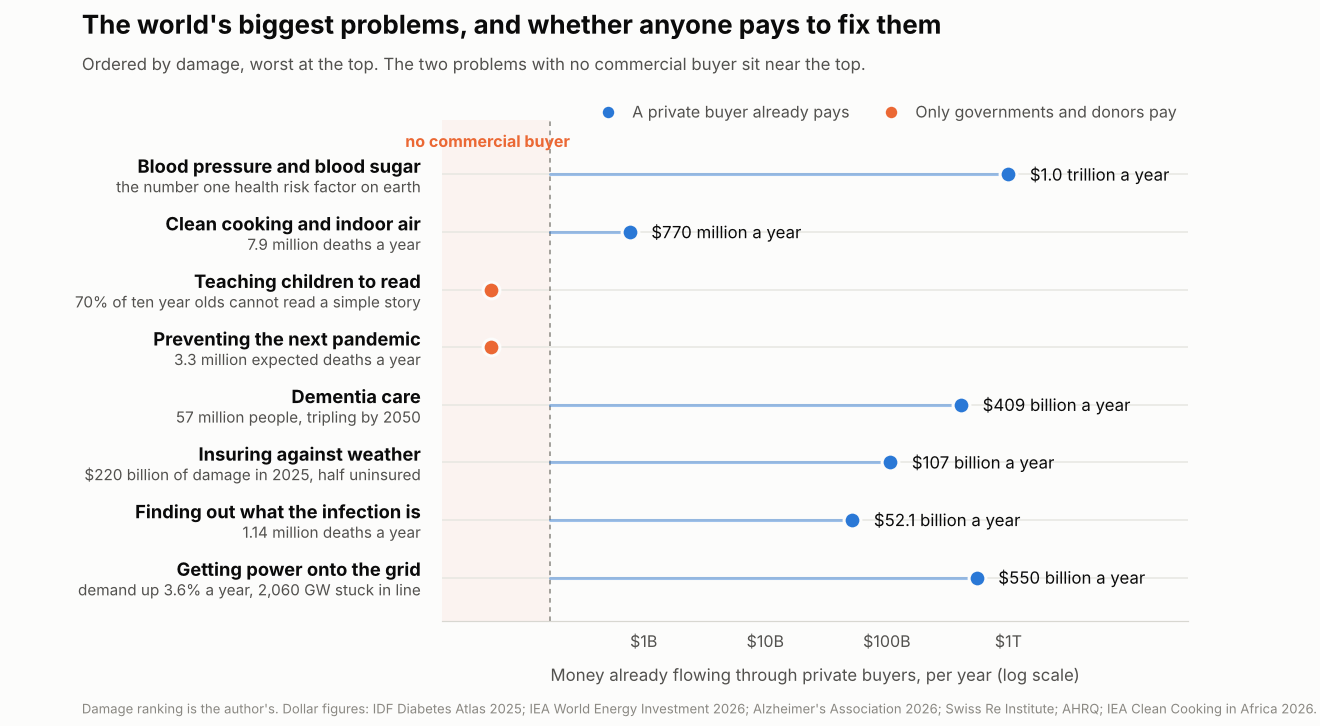
The worst problems in the world and the biggest checks are rarely aimed at the same place. Dementia care is a $409 billion a year bill in the United States. The World Bank puts the lifetime earnings lost to children who cannot read at $21 trillion, and few commercial buyers pay to fix that. This post lists large problems by the damage they do, then asks a second question most lists skip: who writes the check.
The two answers do not line up. Some of the worst problems in the world have almost no commercial buyer, and some of the biggest buyers are lining up behind problems that rank lower on damage. That mismatch is the opportunity, and it is the whole point of this post.
How the problems were chosen
Two measures, both from sources you can check.
Damage. Deaths and years of healthy life lost, mostly from the Global Burden of Disease study, plus economic losses where health data does not apply. The order of the rows is a judgment based on those sources.
Money already flowing. Real spending that exists today, taken from company filings, utility reports and government statistics. Not market forecasts, which cost nothing to produce. A problem with no verifiable number for who is paying is not on this list.
Seven startup opportunities, and who pays
| Opportunity | The damage | Who pays, and how much | What you would build | Biggest risk (judgment) |
|---|---|---|---|---|
| 1. Getting power onto the grid | The IEA projects electricity demand growth averaging 3.6% a year from 2026 to 2030. At the end of 2025, about 2,060 gigawatts of generation and storage sat in American interconnection queues, and projects built in 2025 had waited a median of more than five years. About 75% of the capacity that applied between 2000 and 2020 was withdrawn. | Utilities and the big cloud companies. Global grid investment is approaching $550 billion in 2026 (IEA). American investor-owned utilities spent about $208 billion in 2025 (Edison Electric Institute estimate), plan $239 billion in 2026 and about $1.4 trillion across 2026 to 2030. Press tallies of company filings put 2025 capital spending at the four largest American cloud companies near $410 billion. | Software that shortens the connection study, tools for finding and permitting sites, contracts that let big electricity users turn their load down when the grid is tight. | Your customer is a regulated utility. The buying decision happens in a rate case, not a budget meeting. |
| 2. Getting blood pressure and blood sugar under control | High blood pressure is the single largest health risk factor on earth. About 1.3 billion adults have it and only around one in five has it under control. 589 million adults have diabetes and 252 million of them do not know it. | Insurers, employers and patients. The world spent about $1 trillion on diabetes care in 2024. High blood pressure cost the United States about $219 billion in 2019. Medicare’s drug program spent $27.5 billion on GLP-1 drugs in 2024 before rebates, or about $14 billion after them by KFF’s estimate. | Not new drugs. Everything that turns a prescription into a result: measurement, follow up, adherence, and the handoff between visits. | Payers want claims data showing lower costs before they scale a purchase, and that evidence takes time to collect. Reimbursement is both the moat and the wall. |
| 3. Dementia care and earlier detection | WHO counted 57 million people with dementia in 2021. A Global Burden of Disease forecast projects 153 million adults over 40 with dementia by 2050, up from 57 million in 2019. | Medicare, Medicaid and families. American dementia care will cost about $409 billion in 2026, nearly two thirds of it public money, and $103 billion of it paid out of pocket. Unpaid family caregiving is valued at another $446 billion (2025 figure). | Care navigation, staffing, and detection early enough to change what a family actually does next. | There is no cure, so what you are selling is labor and logistics. Those are thin margin businesses. |
| 4. The shrinking workforce | WHO projects a shortage of 11.1 million health workers by 2030. | Employers who cannot hire. The Bureau of Labor Statistics projects 760,500 average annual openings for home health and personal care aides over 2025 to 2035, with 18% employment growth. Factories installed 542,000 industrial robots in 2024 (IFR). | Automation aimed at the work that cannot be sent offshore: care, construction, food, logistics. | Your buyer is an operator running on very thin margins, and hardware eats cash. |
| 5. Finding out what the infection is, fast | Drug resistant infections directly killed 1.14 million people in 2021 and are forecast to kill 39 million between 2025 and 2050. American hospitals handled 1.81 million sepsis admissions in 2021 at an average of $28,800 each. | Hospitals. Sepsis admissions cost American hospitals $52.1 billion in 2021, up 67% from 2016. | Tests that identify the bug and the right drug at the bedside in hours instead of days, sold on the length of the hospital stay. | Medicare has no payment pathway built for this kind of test, and hospital capital committees move slowly. |
| 6. Clean cooking and indoor air | Air pollution killed 7.9 million people in 2023, and 86% of those deaths were from chronic disease rather than infection. About 2 billion people still cook over open fires or dirty stoves. | Carbon credit buyers, mostly. Investment in clean cooking across sub-Saharan Africa was $770 million in 2024, up from $590 million in 2020 (IEA). Household cookstove projects issued about 26 million carbon credits in the first half of 2025. | Proof. Across all carbon credits, MSCI found that highly rated credits averaged $6.8 a tonne in 2025 while the price gap between top and bottom rated credits passed $7 by year end. That gap is paid for measurement you can trust. | You depend on the carbon credit market, and the entire primary market across every project type was just over $1.4 billion in 2025 (MSCI). |
| 7. Insuring against weather | Current government policies put the world on track for up to about 2.8 degrees of warming (UNEP). Hultgren and colleagues estimate each degree of warming cuts global crop calories by 4.4% of a year’s output. Natural catastrophes caused $220 billion of economic damage in 2025 and about half of it was uninsured (Swiss Re). | Insurers and the people who own the buildings. Public money for adaptation in poorer countries was $26 billion in 2023 against a need of $310 billion a year by 2035 (UNEP). | Pricing risk building by building, and insurance that pays out automatically when a measurement crosses a line, such as a wind speed or a rainfall total, instead of after an adjuster visits. | Public adaptation money covers roughly one twelfth of the stated need, so your customer has to be a private one. |
Why now, for the top three
The grid. In July 2026, the auction that buys backup power capacity for a large part of the eastern United States cleared at its price cap of $325 per megawatt day. At that price the auction cost $16.4 billion and still came up 6,831 megawatts short of the grid operator’s reliability requirement. When an auction hits its own ceiling and still does not clear, the constraint has stopped being theoretical.
Blood pressure and blood sugar. Medicare spent $27.5 billion on GLP-1 drugs in 2024 before rebates, about $14 billion after them by KFF’s estimate. Even the lower figure is a line item that a payer will try hard to shrink, so it is reasonable to expect it to pay for anything that credibly lowers it.
Dementia care. American dementia care costs $409 billion in 2026, and families pay $103 billion of it out of pocket. The labor behind it is short: the Bureau of Labor Statistics projects 760,500 average annual openings for home health and personal care aides and 18% growth through 2035. The shortage is the market.
The pattern worth noticing
Look down the risk column, which is a judgment and not a measurement. In most rows, the thing most likely to kill the company is the customer, not the technology. Three rows depend on slow institutional buyers: rate cases for utilities, Medicare payment rules, and hospital capital committees. The other rows depend on buyers who are short of something: margin in dementia care, cash in the workforce row, a larger market in clean cooking, and a private customer in weather insurance.
That is a different skill than the one most startup advice optimizes for. If you are drawn to these problems, the question to ask is not whether you can build it. It is whether you can survive a buyer who is slow, short of cash, or both.
Two huge problems that are not startup opportunities
Preventing the next pandemic. Marani and colleagues estimate a 1 to 2% chance in any year of a pandemic with an impact like COVID. The IMF estimated COVID’s cost to the global economy at $13.8 trillion through 2024. A World Bank and WHO analysis puts full global preparedness at $31.1 billion a year, with a $10.5 billion gap in international funding. The return on that spending is large, and almost only a government can capture it. A founder has no obvious customer here.
Teaching children to read. The World Bank’s modelled estimate for 2022 is that about 70% of ten year olds in low and middle income countries cannot read and understand a simple story. 273 million children are out of school. The World Bank puts the lifetime earnings lost at $21 trillion, about 17% of global output. The buyers are education ministries and donors, and both pay on timelines few startups survive.
By the damage measures above, these are among the most important problems on the list. They are not obvious opportunities. Those are different claims, and collapsing them is how well meaning people lose a decade.
Sources
Damage figures: Institute for Health Metrics and Evaluation, Global Burden of Disease 2023; State of Global Air 2025; GRAM drug resistance study, The Lancet, 2024; WHO Global Report on Hypertension; IDF Diabetes Atlas, 11th edition; WHO dementia fact sheet; WHO health workforce projections; UNEP Emissions Gap Report 2025; Hultgren and colleagues, Nature, 2025; Marani and colleagues, PNAS, 2021; World Bank learning poverty report; UN education report 2026.
Money figures: IEA World Energy Investment 2026; IEA Electricity 2026; Edison Electric Institute; Berkeley Lab, Queued Up 2026; PJM capacity auction, July 2026; hyperscaler spending from company filings with the SEC as tallied in the press; KFF on Medicare GLP-1 spending; CDC high blood pressure facts; Alzheimer’s Association 2026 Facts and Figures; CMS National Health Expenditures; Bureau of Labor Statistics; International Federation of Robotics; AHRQ on sepsis costs; IEA Clean Cooking in Africa 2026; MSCI Carbon Markets; Climate Focus voluntary carbon market review; Swiss Re Institute; UNEP Adaptation Gap Report 2025; World Bank and WHO on pandemic preparedness financing; IMF on the cost of COVID; analysis of the 2027 Medicare hospital payment rule; PASTEUR Act, H.R. 7352.
One number is deliberately excluded. The widely quoted claim that climate change has already committed the world to $38 trillion a year in damages came from a paper in Nature that was retracted in December 2025 over faulty data. Any figure that cites it is unreliable.
Discover more from Laurie Stach
Subscribe to get the latest posts sent to your email.

