
Three broad topics, practical guidance, seeking information and writing, make up about 78 percent of what people ask ChatGPT, and no single AI assistant leads on all of them. ChatGPT still draws 56.4 percent of visits to AI chatbot websites, but in this scorecard Claude rates highest on writing and data analysis, Gemini on translation, and ChatGPT on math and images.
So the useful question is which tool fits the tasks you actually do. Quick picks from the scorecard come first, followed by the evidence: what people use AI for, which assistants they use, and how eight of them score on each task. The 1 to 5 ratings are judgments informed by the public leaderboards linked below, not scores published by any benchmark.
| If your main task is | Highest rated in this scorecard |
|---|---|
| Writing and editing | Claude |
| Learning, how-to advice, looking up facts | ChatGPT and Claude (tied) |
| Health questions | ChatGPT, Gemini, Claude and Copilot (tied) |
| Translation | Gemini (the least certain rating here, see below) |
| Coding, long documents | ChatGPT and Claude (tied) |
| Images, math | ChatGPT |
| Data analysis, personal support | Claude |
Updated November 1, 2026. Usage data runs through September 2026. Figures that could not be confirmed against a primary page on November 1 have been left out or replaced with ones that could; the ratings rest on the leaderboards linked in the sources, last reviewed October 7 to 11, 2026. AI tools change monthly, so check the dates before relying on any single number.
What people actually use AI for
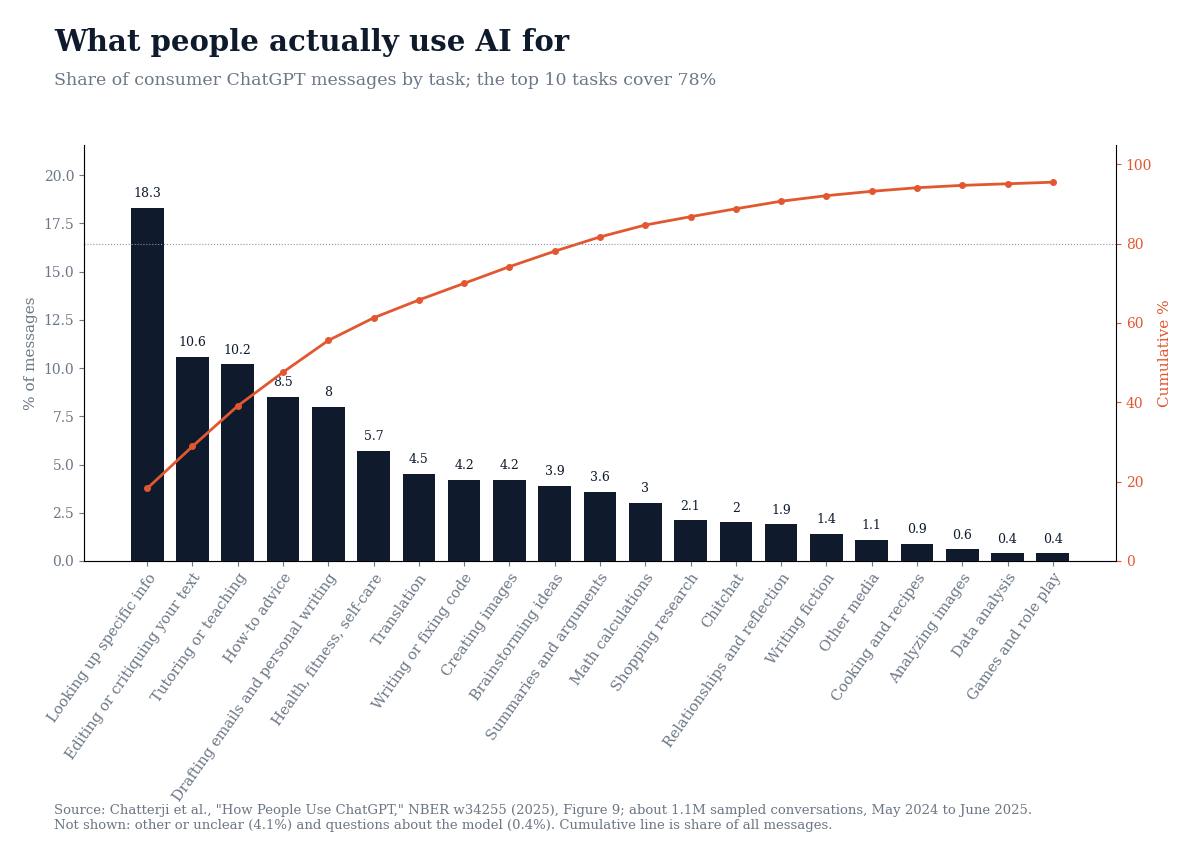
The largest look at real usage comes from OpenAI’s own researchers, who classified about 1.1 million sampled consumer ChatGPT conversations from May 2024 to June 2025 into 24 task types (NBER Working Paper 34255). By topic, practical guidance is about 29 percent of messages. Seeking information rose from 14 percent in July 2024 to 24 percent in July 2025, while writing fell from 36 percent to 24 percent. Within practical guidance, tutoring is 10.2 percent of all messages and how-to advice 8.5 percent.
Three patterns stand out.
- Most writing help is editing. About two thirds of writing requests ask the AI to change text the person already wrote, through editing or critiquing, translating or summarizing. Writing is also about 40 percent of work-related messages, the largest work use by far.
- Coding is bigger than it looks. It is only 4.2 percent of ChatGPT messages, partly because much programming has moved into dedicated coding tools. On Claude.ai, computer and math tasks were about 35 percent of conversations in early 2026 (Anthropic Economic Index, March 2026), and in 2025 coding tools took 4.0 billion dollars, 55 percent of departmental enterprise AI spending (Menlo Ventures).
- Some popular assumptions are wrong. Companionship is often called the top use of AI. The paper’s relationships and personal reflection category is 1.9 percent of ChatGPT messages, and 4 percent of US adults say they ever use a chatbot for companionship, against 10 percent for emotional support or advice (Pew Research Center, 2026).
OpenAI’s newer data, released in August 2026, shows two shifts since that study. Images and other media are the fastest growing category, at 7.8 percent of consumer messages in the second quarter of 2026, after ChatGPT Images 2.0 launched in April. And people are more than twice as likely to use ChatGPT to do a task or create something at work as outside work (OpenAI).
Which AI people actually use
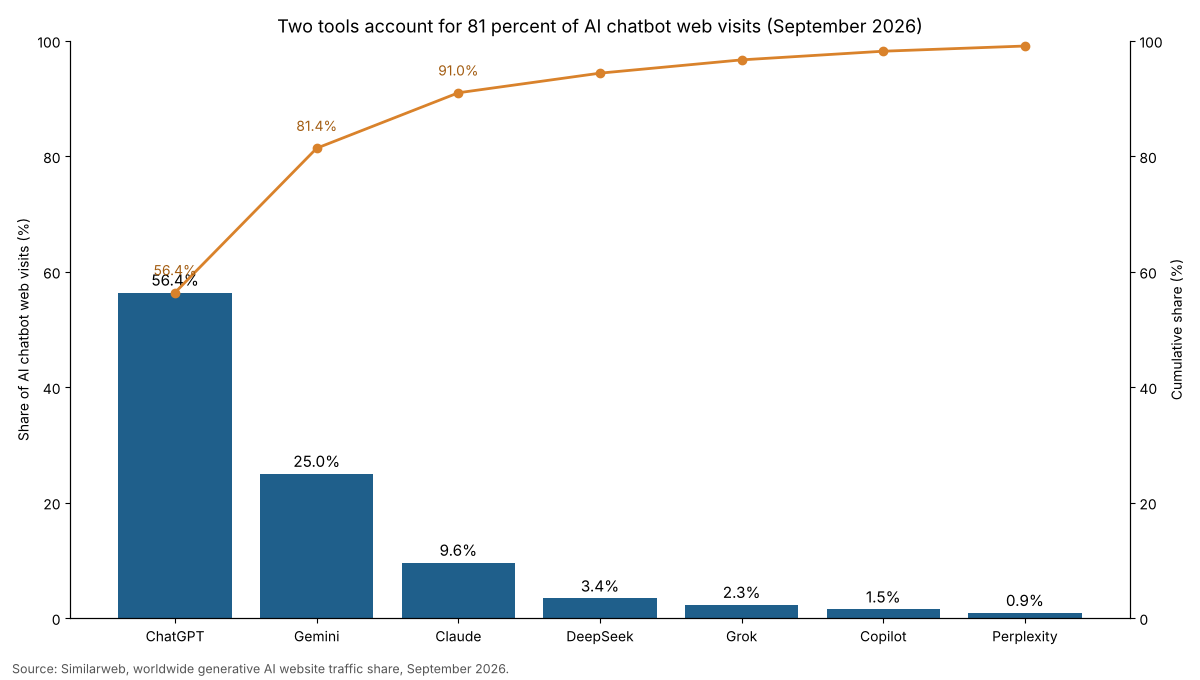
ChatGPT took 56.4 percent of worldwide visits to AI chatbot websites in September 2026. Gemini is second at 25.0 percent and Claude is third at 9.6 percent. ChatGPT and Gemini together account for 81.4 percent of visits (Similarweb data, as reported by Xataka and Merca2).
Company disclosures point the same way, though each uses a different unit. OpenAI reported more than 900 million weekly active users as of March 31, 2026, and said it expected to reach 1 billion soon (OpenAI). Google reported more than 1 billion monthly Gemini app users in August 2026 (SiliconANGLE). Meta reported more than 1 billion monthly Meta AI users in May 2025 and has not given a newer count. On its October 28, 2026 earnings call, Microsoft said Copilot daily users rose nearly 50 percent in the quarter and gave no total (UC Today). Anthropic does not appear to publish a user count.
Business use flips the ranking. In Ramp’s September 2026 data on more than 85,000 US businesses, 43.8 percent paid Anthropic and 40.6 percent paid OpenAI; Ramp counts businesses with a payment to a vendor, not usage or revenue, and says it is not US-wide market share (Ramp AI Index). Menlo Ventures’ late 2025 survey put Anthropic at 40 percent of enterprise LLM API spend, OpenAI at 27 percent and Google at 21 percent. Claude is third with consumers on the web and first with companies on these two measures.
The scorecard
Each assistant is rated 1 to 5 on the main use cases. Ratings are judgments informed by the leaderboards linked in the sources, using the strongest model available inside each app on its paid plan as of the October review. An asterisk marks a rating based on product features because no benchmark exists. Microsoft Copilot is rated as Microsoft 365 Copilot, which runs both OpenAI and Anthropic models. The weighted average uses only shares stated in the NBER paper’s text.
| Use case | Weight (share of ChatGPT messages) | ChatGPT | Gemini | Claude | Copilot | Meta AI | Grok | Perplexity | DeepSeek |
|---|---|---|---|---|---|---|---|---|---|
| Writing group: editing, drafting, translation, summarizing (average of the three rows below) | 24% | 4.3 | 4.3 | 4.7 | 3.7 | 3.7 | 3.0 | 3.0 | 3.0 |
| Writing: editing, drafting emails, brainstorming | 4 | 4 | 5 | 4* | 4 | 3 | 3* | 3 | |
| Translation | 4 | 5 | 4 | 4* | 3 | 3 | 3* | 3 | |
| Summarizing long documents | 5 | 4 | 5 | 3* | 4 | 3 | 3* | 3 | |
| Learning and how-to advice | 18.7% | 5 | 4 | 5 | 4* | 3 | 3 | 3* | 3 |
| Looking up facts (seeking information) | 24% | 5 | 4 | 5 | 4* | 2 | 4 | 4* | 2 |
| Writing and fixing code | 4.2% | 5 | 3 | 5 | 4* | 2 | 3 | 2* | 2 |
| Math | 3.0% | 5 | 3 | 4 | 4* | 3 | 2 | 3* | 2 |
| Personal reflection and support | 1.9% | 3 | 3 | 4 | 3* | 1 | 1 | 2* | 2* |
| Data analysis and spreadsheets | 0.4% | 4 | 3* | 5 | 4* | 2 | 2 | 2* | 2 |
| Health questions (not weighted) | no confirmed share | 4 | 4 | 4 | 4* | 3 | 2 | 3* | 2 |
| Creating images (not weighted) | 7.8% in Q2 2026, a different period | 5 | 4 | 2* | 4 | 3 | 4 | 2* | 1* |
| Shopping research (not weighted) | no confirmed share | 4* | 4* | 2* | 4* | 2* | 2* | 4* | 1* |
| Weighted average (rows with a confirmed share) | 76.2% covered | 4.73 | 3.98 | 4.83 | 3.87 | 2.78 | 3.22 | 3.23 | 2.56 |
What each row rests on. The ratings are judgments, and several rows have thin or dated evidence, which is noted:
- Overall capability: On Artificial Analysis’s Intelligence Index (an aggregate, not task specific, with no date on the page), a Gemini 4 model leads at 59, Claude Opus 5.5 follows at 58 and GPT-6 Astra at 57. Gemini’s ratings here may therefore understate it.
- Writing: LMArena’s text leaderboard is the main public evidence, but the version available for checking on November 1 was dated November 2025, so no current standing is cited. Gemini 4 Argon reached Google AI Pro and Ultra subscribers in the Gemini app on October 13, 2026 (Thurrott), after the ratings were set. The writing scores for Copilot, Meta AI, Grok, Perplexity and DeepSeek are weaker still.
- Learning: Humanity’s Last Exam (Scale AI, CAIS) tests expert knowledge and reasoning, not teaching quality, so it gives only a rough ordering.
- Looking up facts: LMArena’s search leaderboard is the public evidence. Perplexity’s rating reflects citations and product design rather than a leaderboard rank.
- Health: The main public benchmark is OpenAI’s HealthBench, which OpenAI built. Ratings here are close together on purpose.
- Translation: The Gemini rating rests on the 2025 WMT machine translation evaluation of an older Gemini model. This is the least certain rating in the table.
- Code: The Terminal-Bench leaderboard and LMArena’s web development board are the public evidence; Gemini’s coding rating rests on thinner evidence.
- Images: LMArena’s text to image board is the public evidence. Claude has no image model of its own: Adobe’s connector for Claude, expanded to more than 80 tools on September 24, 2026, can create and edit images through Adobe apps (Newsshooter), and Claude draws charts and diagrams with code. DeepSeek does not generate images in this scorecard.
- Long documents: The weakest evidenced row. It rests on vendor-stated context windows, and no independent recall benchmark is cited.
- Math: MathArena’s September 2026 round had OpenAI models on top (GPT-6.1 Sol at 84.0% and GPT-6 Astra at 81.8%), with the best open model, Kimi K3.1 Pro, at 59.6%. Epoch AI’s FrontierMath Tier 4 is a set of 43 research level problems. Gemini, Grok and Claude scores in this row rest on less evidence.
- Shopping: No independent accuracy benchmark exists. Ratings reflect product research and checkout features, such as Perplexity’s Instant Buy checkout with PayPal, launched in November 2025 (PYMNTS).
- Personal support: Common Sense Media rated ChatGPT for Teens an “unacceptable risk” in October 2026, a rating OpenAI disputes (Engadget). That rating covers a teen product, not the adult app. The other scores in this row are judgments with no cited benchmark.
- Data analysis: No benchmark is cited. Claude’s lead here is a judgment based on its spreadsheet and analysis features.
When each tool is most valuable
| Tool | Most valuable for | Weakest at |
|---|---|---|
| ChatGPT | An everyday default: math, images, voice, health questions, looking things up | Video (OpenAI shut down the Sora app in April 2026 and its API in September 2026) and teen safety ratings |
| Claude | Coding, spreadsheets and data analysis, long documents, writing and editing | Images (no image model of its own; it can create them only through connected tools such as Adobe’s connector) |
| Gemini | Translation, video, and anything inside Gmail, Docs and Google Workspace | Complex code and math with the models rated here; Gemini 4 Argon, available to Pro and Ultra subscribers since October 13, is not yet rated |
| Copilot | Work inside Outlook, Word, Excel and Teams, with OpenAI and Anthropic models built in | Little added value outside Microsoft 365 |
| Perplexity | Quick answers with citations and product research with built in checkout | Coding and deep reasoning |
| Grok | Images and real time posts from X | Personal support, which it scores lowest on here |
| Meta AI | Quick questions inside WhatsApp, Instagram and Facebook | Coding |
| DeepSeek | A low cost, open model for text tasks | Images (no image generation found) and integrations |
What this does not show
Ratings reflect leaderboard reviews from October 7 to 11, 2026, and product changes after that date are not scored. Usage data runs from May 2024 to September 2026 depending on the source. Benchmarks often test models before they reach the app: Gemini 4 Argon reached the Gemini app only for Google AI Pro and Ultra subscribers on October 13, 2026. Releases reported after the review are not rated, including Claude Duet, which Anthropic announced on October 21 as a research preview. Ratings reflect each app’s strongest model on paid plans; free plans run smaller models. Several scores are reported by the companies that built the models, and the gaps between the top three tools on many boards are within the margin of error. The usage figures measure different things: OpenAI’s task data covers consumer ChatGPT accounts and excludes business accounts, Similarweb counts web visits only and misses app use, and Ramp counts which companies pay a vendor, not how much they use it.
How to use this
Pick your three most common tasks from the scorecard. Use the tool with the highest score on each. For most people that means two tools: a generalist for everyday questions and a specialist for the work that matters most to them.
Sources: Chatterji, Cunningham, Deming et al., “How People Use ChatGPT,” NBER Working Paper 34255, 2025 (PDF). OpenAI Signals, “How the world is putting ChatGPT to work,” August 2026. OpenAI, Accelerating the next phase of AI. Anthropic Economic Index reports: January 2026, March 2026, June 2026. Menlo Ventures, “2025: The State of Generative AI in the Enterprise.” Pew Research Center, “Americans and AI,” June 2026. Similarweb September 2026 traffic share, via Xataka and Merca2 (secondary). Ramp AI Index. SiliconANGLE on Gemini’s 1 billion monthly users, August 2026. UC Today on Microsoft’s October 2026 earnings. Artificial Analysis Intelligence Index. Thurrott on Gemini 4 Argon, October 13, 2026. The Decoder on the Sora shutdown. Newsshooter on Adobe’s connectors for Claude and Gemini. LMArena leaderboards: text, web development, search, text to image. Terminal-Bench. Humanity’s Last Exam, Scale AI. MathArena. Epoch AI FrontierMath. Engadget on Common Sense Media’s ChatGPT for Teens rating. PYMNTS on Perplexity and PayPal Instant Buy.
Discover more from Laurie Stach
Subscribe to get the latest posts sent to your email.

