
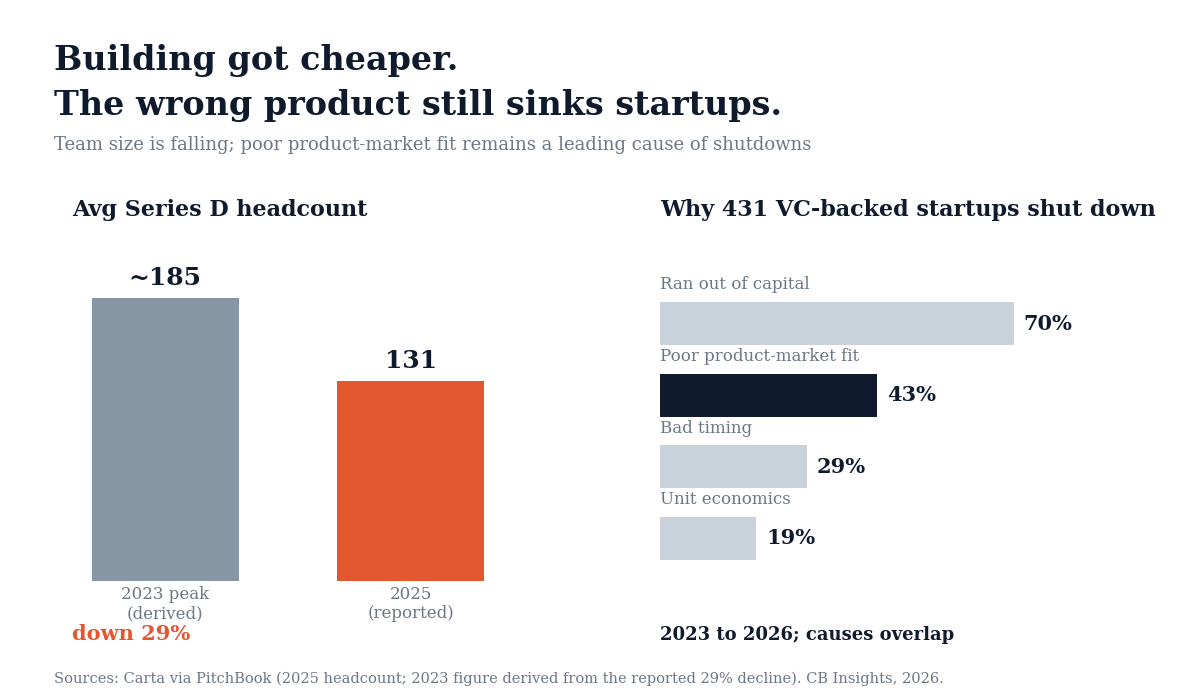
AI is making software cheaper to build: Carta data show the average Series D startup now runs with 29 percent fewer people than at the 2023 peak. The cost of building the wrong thing has not come down with it: poor product-market fit still shows up in 43 percent of venture-backed shutdowns since 2023.
That asymmetry is the entire story, and most of the current excitement is aimed at the wrong half of it.
What actually got cheaper
In a controlled experiment run by Microsoft Research and GitHub, developers given access to Copilot completed a defined task, implementing an HTTP server in JavaScript, 55.8 percent faster than developers without it. That is a large effect on a clean, self-contained problem.
Now the complication. In 2025, METR ran a randomized controlled trial with 16 experienced open source developers working 246 real issues in their own repositories, codebases averaging more than a million lines of code. Developers were randomly permitted or forbidden to use AI on each issue. They were 19 percent slower when allowed to use it, with a confidence interval running from 2 to 39 percent slower.
They also could not tell. Before starting, these developers forecast a 24 percent speedup. After finishing, having measurably been slowed down, they still believed AI had sped them up by about 20 percent.
The two studies measured different things. One was a greenfield benchmark task. The other was a large, mature codebase with a high review bar. Both are real randomized trials, and citing either one alone would be misleading. METR’s 2026 attempt to update the result could not produce a reliable number, though METR says developers are likely faster with today’s tools than they were in early 2025.
The structural evidence is steadier. Carta data reported by PitchBook show average Series D headcount fell 29 percent from its 2023 peak, to 131 employees in 2025, and Series B averages fell from 53 to 45. New hiring at venture backed companies in January 2026 was the lowest for any January since 2018, down 65 percent from the January 2022 peak. Tighter funding drove part of that decline, so these figures overstate AI’s share, but the direction is consistent.
Whatever the true figure for an individual engineer, companies are reaching later stages with fewer people. Building is cheaper.
What did not get cheaper
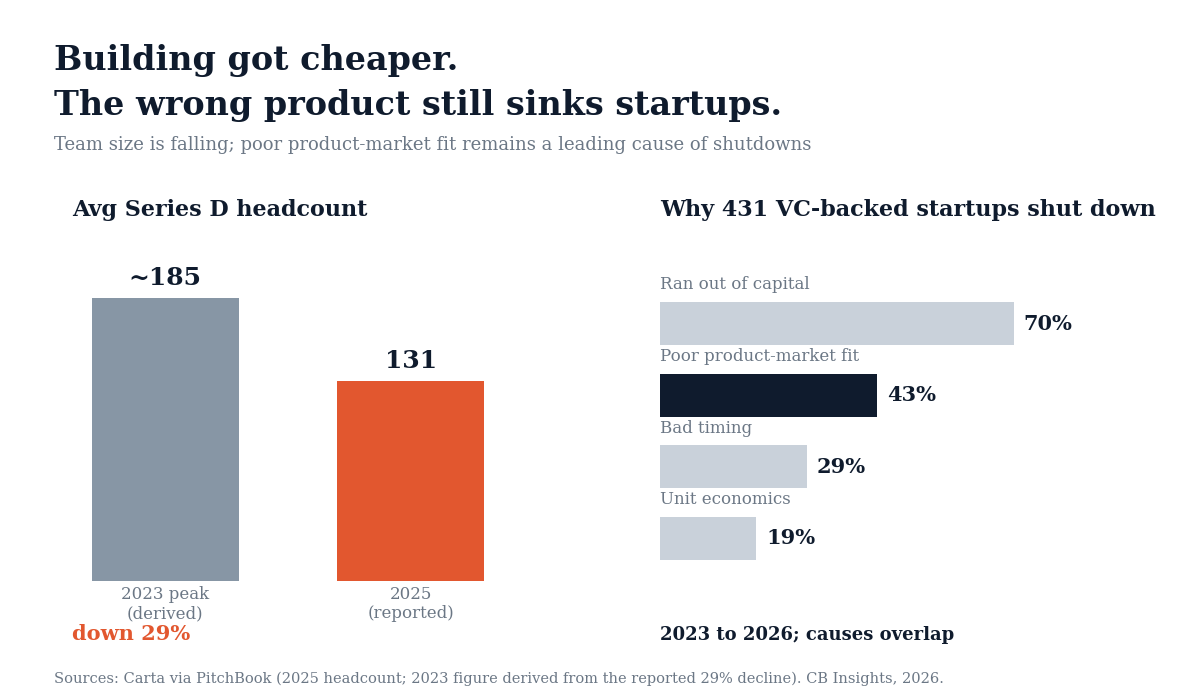
CB Insights analyzed 431 venture backed companies that shut down between 2023 and 2026. Poor product-market fit appeared in 43 percent of those failures. Running out of capital appeared in 70 percent, which CB Insights explicitly labels the final cause of death rather than the root problem. Bad timing accounted for 29 percent, unsustainable unit economics for 19 percent.
The median company in that set raised 11 million dollars before dying. The median time from last fundraise to shutdown was 22 months.
After a decade of dramatically better tooling, building the wrong product still sits behind 43 percent of failures.
Speed only pays when it tests the premise
Cheap, fast building lets you run more cycles and correct course sooner, but only when each cycle is attached to something that tests the premise.
A 2011 Startup Genome study of more than 3,200 high growth technology startups found that companies that pivoted once or twice raised 2.5 times more money than companies that either pivoted more than twice or never pivoted at all. They also had 3.6 times better user growth and were 52 percent less likely to scale prematurely.
Both tails lose. Never correcting and constantly correcting both underperform. What wins is a small number of deliberate corrections, which is what a functioning learning loop produces.
The same dataset found 70 percent of startups scaled prematurely on at least one dimension, and that 93 percent of those never reached 100,000 dollars in monthly revenue.
Two people, identical tools
One ships five versions in a quarter. Each version goes in front of people who could plausibly pay. Each one answers a question the last version raised. By version five the premise has either survived contact with reality or been replaced by a better one.
The other also ships five versions in a quarter. All five are refinements of the same unexamined assumption about what someone wants. The code is good. The velocity is real. Nothing in the loop was ever pointed at the premise.
Before AI, the second person ran out of money before they ran out of conviction. The expense of building acted as an accidental brake. That brake is gone. The tooling did not create this failure mode. It removed the constraint that used to limit how far the failure mode could run.
That is why I wrote about how I use AI to pressure-test an idea before building anything with it.
What this does not prove
Every dataset here has a weakness. Startup failure statistics come from post mortems founders chose to write, a self-selected sample with self-diagnosed causes; a peer reviewed coding of 214 post mortems in Sustainability found the dominant pattern was no structured business development strategy, a broader cause than market need. The widely quoted 42 percent “no market need” figure comes from an older CB Insights set of about 101 post mortems and uses a different category, so it cannot be compared directly with the 43 percent here. The Startup Genome data is from 2011. The productivity trials measure time on tasks, not company outcomes. No study yet links AI build speed to survival. What holds up is the asymmetry: the measures of build cost point down, and the share of failures traced to the wrong product remains high.
AI may also make the wrong thing more likely
Cheaper building may not be the only effect. Used heavily, AI can also make a wrong idea easier to believe. Chatbots give more positive feedback on arguments a user says they like or wrote. Across 11 leading models, AI affirmed users about 50 percent more often than people did, and users left more convinced they were right. People solving reasoning problems with AI overestimated their own scores, and knowledge workers who trusted AI more reported doing less critical thinking. No study yet measures whether founders who lean on AI pick the wrong product more often, but each of these findings points that way, and the risk is highest when founders ask AI to judge their own idea in place of putting it in front of buyers.
What to do about it
If building is nearly free, the scarce thing is a question sharp enough that the version answers it. That discipline is harder now, because no cost pressure forces you to ask, and it belongs on the list of questions AI cannot answer for you.
Before you build your next version, write down the one question it has to answer and name the people who could plausibly pay that you will put it in front of. If you cannot name both, do not build it yet.
Sources: Peng, Kalliamvakou, Cihon & Demirer, “The Impact of AI on Developer Productivity: Evidence from GitHub Copilot,” 2023. Becker, Rush, Barnes & Rein, METR randomized controlled trial, July 2025, and METR, “We are Changing our Developer Productivity Experiment Design,” February 2026. CB Insights, startup failure analysis of 431 companies, 2026, and its earlier 101 company analysis. Carta, State of Startup Compensation H2 2025, as reported by PitchBook, May 2026. Startup Genome Report, Premature Scaling, 2011. Cantamessa, Gatteschi, Perboli & Rosano, “Startups’ Roads to Failure,” Sustainability 10(7), 2018. Sharma et al., “Towards Understanding Sycophancy in Language Models,” ICLR 2024. Cheng et al., “Sycophantic AI decreases prosocial intentions and promotes dependence,” 2025. Fernandes et al., “AI makes you smarter but none the wiser,” Computers in Human Behavior 175, 2025. Lee et al., “The Impact of Generative AI on Critical Thinking,” CHI 2025.

