
I hear the same thing constantly from friends, students, founders, and clients: everyone else has figured out something I have not.
The national data does not support that. Gallup found 52 percent of U.S. employees use AI at work at least a few times a year, up from 27 percent two years earlier, but only 13 percent use it daily. The U.S. Census Bureau’s March 2026 survey put roughly 55 percent of workers as having used AI for at least one work task, with about 24 percent of those users reporting daily use in the prior week. Daily use is a minority position, not a standard you are failing to meet.
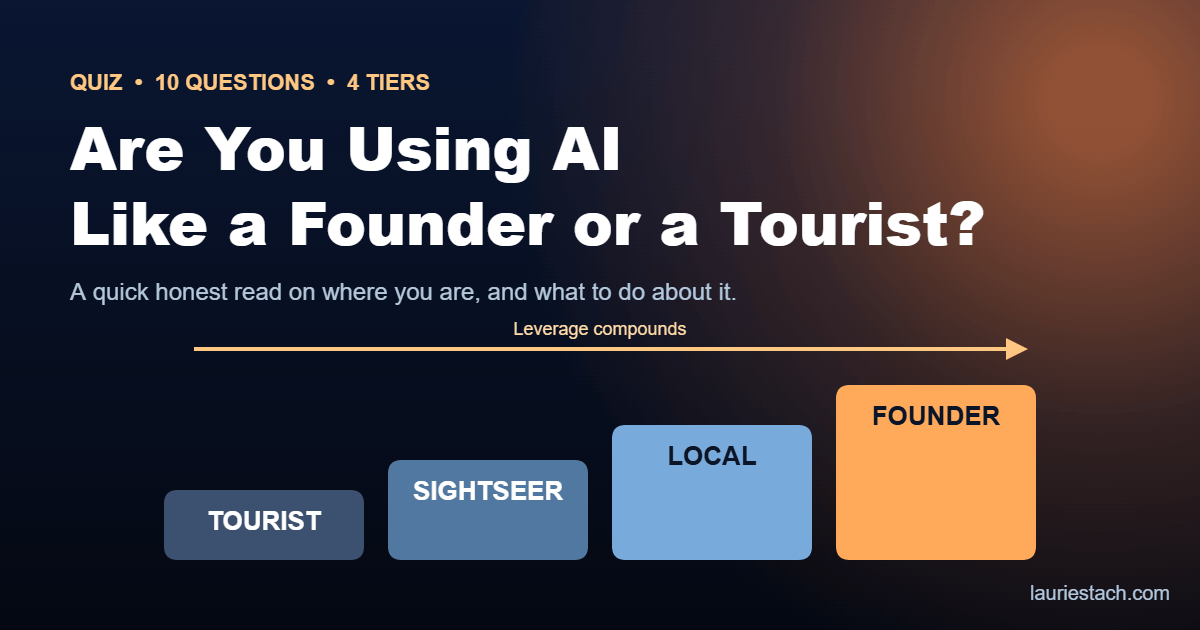
What the aggregates cannot tell you is where you personally sit. There are four distinct relationships people have with this tool, and they are not interchangeable.
This quiz tells you which one you are. Honestly. Quickly. And it tells you what to do next.
The Four Archetypes
Tourist. You have heard about AI. You have tried ChatGPT once or twice. It felt like a novelty. You moved on. AI is something other people get excited about, not something that touches your day.
Sightseer. You use AI occasionally for fun, for one off questions, for a draft email when you cannot start one yourself. It is a sometimes thing. It is not infrastructure. You think you should probably use it more, but the moment never quite comes.
Local. You use AI several times a day. You have your favorite tools. You have learned what works. You get real value from it across writing, research, brainstorming, and analysis. Your peers notice you are faster than you used to be, and you know why.
Founder. AI is part of how you think and work. You have built workflows, prompt libraries, and an honest sense of what AI is actually good at versus where it bluffs. You treat AI confidence as a starting signal, not a conclusion. Your leverage compounds. Your peers cannot quite explain why your output looks the way it does.
There is no judgment in any of these labels. Plenty of Tourists are extraordinary at what they do, today. The question this quiz is built to answer is whether you are still going to be extraordinary in eighteen months, when your peers are operating with three times the leverage.
The Quiz
Ten questions. Each answer is worth 1 to 4 points. Add them up at the end. No cheating, the whole point is an honest read.
1. In a typical work week, how often do you use AI?
A. Never, or just to try it occasionally (1)
B. A few times for quick lookups or fun (2)
C. Multiple times every day across different work (3)
D. Continuously. AI is part of most of my work blocks (4)
2. When you start a new project or problem, when does AI come in?
A. Rarely or never (1)
B. Sometimes, partway through, for a specific task (2)
C. Often, for research and first drafts (3)
D. From the first thought. AI helps me structure how I even frame the problem (4)
3. When you write a prompt, what does it usually look like?
A. A short question, the way I would ask a friend (1)
B. A sentence or two, refined once if the first answer is bad (2)
C. Structured prompts with context, role, examples, and the output format I want (3)
D. Reusable templates I have refined across many sessions, with strong context priming (4)
4. When AI gives you an answer, what do you do with it?
A. Trust it and move on (1)
B. Skim it for obvious errors (2)
C. Push back, ask for sources, verify independently when it matters (3)
D. Run a verification workflow for high stakes output. AI confidence is a signal, not a conclusion (4)
5. Which AI tools do you actually use?
A. One of them, once or twice (1)
B. One of ChatGPT, Claude, or Gemini, regularly (2)
C. Two or three tools, switching depending on the task (3)
D. A real stack: chat, coding, image, research, automation. I know which one excels at what (4)
6. Do you save prompts or workflows for reuse?
A. No, I start from scratch every time (1)
B. I sometimes copy a useful response into a doc (2)
C. I keep a notes file of prompts that worked (3)
D. I have an organized library of prompts, agents, or workflows by use case (4)
7. When AI helps you write, what is the relationship?
A. I copy what AI produces (1)
B. I lightly edit AI output (2)
C. AI gives me a draft. I substantially rewrite in my own voice (3)
D. AI is a sparring partner. My voice and judgment shape the piece. AI handles structure and pace (4)
8. How much do you spend on AI tools each month?
A. $0 (1)
B. Under $25 (2)
C. $25 to $99 (3)
D. $100 or more, such as a Max or Pro tier, or several subscriptions plus API budget (4)
9. When was the last time you tried a new AI capability or tool?
A. I cannot remember (1)
B. A few months ago (2)
C. This month (3)
D. This week (4)
10. If your AI tools disappeared tomorrow, what would change?
A. Nothing meaningful (1)
B. I would be slightly slower on a few tasks (2)
C. My productivity would drop noticeably (3)
D. Several workflows would break. I would have to rebuild fundamentally (4)
Add Up Your Score
Minimum possible: 10. Maximum possible: 40. Find your tier below.
One caveat before you read your result. This is a self-assessment heuristic, not a validated instrument. The four tiers and the cut points between them are descriptive categories I chose, not thresholds derived from data, and no one has tested whether they predict anything. The questions are worth answering. The number is worth holding loosely.
10 to 17 points: Tourist
You are not in the game yet. The share of U.S. employees using AI at work roughly doubled in two years, from 27 percent to 52 percent in Gallup’s data, so the group you are being compared against is growing quickly. How fast any individual gap widens is not something anyone has measured, so treat that as unknown. What is known is that the entry cost is low. The only hard part is starting.
Your move this week. Pick the single task you spend the most repetitive time on. Writing email replies. Summarizing meetings. Drafting briefs. Researching prospects. Run that exact task through Claude or ChatGPT every single time it comes up for the next two weeks. Do not optimize. Do not try to learn everything. Just get reps. By the end of two weeks you will have a real sense of what AI does well and where it falls short, and you will have a starting point you can build on.
18 to 25 points: Sightseer
You have experimented but you have not committed. AI is novelty, not infrastructure. If your plan is to use it more soon, the habit research is not encouraging about plans. Lally and colleagues (2010) tracked 96 people forming a single daily behavior and modeled automaticity as a function of repetition in a consistent context, plateauing at a median of 66 days with a range from 18 to 254. Intention was not the mechanism in that model. Repetition in the same context was.
Your move this month. Pick three recurring tasks: writing first drafts, summarizing meetings, and research synthesis are common starting places. For 60 days, force every instance of those three tasks through AI before you do it any other way. Sixty is closer to the 66 day median in the Lally data than the 30 day figure that circulates online. Track which ones get faster, which get better, and which get worse. Lally also found that missing a single occasion did not materially affect the process, so do not restart the count over one lapse. At the end you will have your own data on where AI earns its keep in your specific work.
26 to 33 points: Local
You have built real fluency. AI is part of how you work. The risk at this tier is plateau: once a tool becomes comfortable, nothing forces you to push it further. How many people move up from here, and how long it takes, is not something I have data on. Treat the step below as an experiment, not a timeline.
Your move this quarter. Pick the area of your work where AI is underutilized relative to its potential. For most people that is research synthesis, strategy work, or some flavor of creative output. Build a structured prompt library for that area. Three to five reusable prompts with strong context priming. Test them, refine them, and watch what happens to your output quality. The Local to Founder jump is mostly about depth and reusability, not about more tools.
34 to 40 points: Founder
You are operating with significant leverage. The risk at this tier is not underuse. It is overuse, and unlike most claims in this genre it is documented. Parasuraman and Manzey (2010) reviewed automated decision support across aviation, medicine and military settings and separated two failures: complacency, meaning reduced monitoring of the automated system, and automation bias, meaning adopting its output without independent verification. Both produced errors of omission and commission.
Your move this year. Sharpen your judgment about when not to use AI. The genuinely hard questions in your field, the ones that require deep domain expertise, taste, and pattern recognition built from your specific experience, are also the ones where verification is hardest, because your own judgment is the only available check. Identify those decisions explicitly. Decide which categories of choice you will always make manually, with AI in a sidecar role at most. Founders compound their advantage by knowing the boundary between AI assisted work and irreducibly human work.
What This Quiz Is Actually Measuring
This is not really a quiz about AI tools. It is a quiz about how willing you are to change the way you work in response to a fundamentally new capability. AI is the most useful proxy available right now, but the underlying skill is broader: the ability to recognize when a new technology has crossed the threshold from novelty to leverage, and to restructure your work fast enough to benefit before everyone else catches up.
The Tourist is not really anti AI. The Tourist is a person whose default is to wait until something is obvious before adapting. That default has historically been fine, sometimes even smart. What has measurably changed is the speed of diffusion. Bick, Blandin and Deming found generative AI reached 39.5 percent adoption among U.S. adults within roughly two years, against about 20 percent for the internet at two years and 20 percent for the personal computer at three. The Founder is not necessarily smarter or more technical. The Founder is a person whose default is to integrate new capability fast, fail at it cheaply, and accumulate compounded judgment about what works.
One common objection deserves evidence rather than opinion: that seniority or deep expertise makes the overuse risk someone else’s problem. The automation bias literature does not support it. Parasuraman and Manzey found the effect in expert and novice participants alike, and reported that it is not removed by training or instruction on its own. Experience changes what you are good at. It does not appear to change how readily you accept a machine’s answer.
One Last Thought
The four archetypes are not permanent. What follows is observation, not data: I have watched people go from Tourist to Local in a quarter once they committed, and I have watched Founders drift back to Local after they got comfortable and stopped experimenting. The tier is not who you are. It is what you are doing right now.
Whichever tier you landed in, the prescription is the same: pick one thing this week, do it differently, and see what happens.
If you took this quiz, I would love to know where you landed. Drop a comment with your score and your tier. The more honest the comments, the more useful the conversation.
Sources: Gallup, U.S. workplace AI adoption, 2026; U.S. Census Bureau, AI use at work, March 2026 and August 2026 releases; Bick, Blandin & Deming, “The Rapid Adoption of Generative AI,” NBER Working Paper 32966, published in Management Science (2025); Lally, van Jaarsveld, Potts & Wardle, “How are habits formed: Modelling habit formation in the real world,” European Journal of Social Psychology 40 (2010); Parasuraman & Manzey, “Complacency and Bias in Human Use of Automation: An Attentional Integration,” Human Factors 52 (2010).

