

“The key is not spending time but investing it.”
– Stephen R. Covey
Time Is Your Most Valuable Startup Resource
Mastering your time is essential to being a successful entrepreneur. It is your most precious and non-renewable resource, and how you allocate it can directly determine whether your company thrives or stalls. Yet prioritizing effectively isn’t always intuitive — especially in the early stages, when everything feels urgent and equally important.
The real challenge is learning to balance thinking big with thinking small.
You need a clear big-picture roadmap: where you want to go, what success looks like, and the major milestones required to get there. From there, those milestones must be broken down into smaller, achievable steps with measurable success metrics to ensure you stay on course. Once that structure is clear, you can evaluate the most time-efficient ways to reach each goal.
Let’s break this process down.
Define Your True Growth Milestones
Start by identifying the milestones that actually signal meaningful progress. These should reflect real traction, not just busywork.
Examples include:
- Launching pre-orders
- Releasing a beta product
- Reaching 1,000 customers
- Hitting 100 daily website visitors
- Shipping your first physical product
Once defined, estimate how long each milestone should realistically take — then challenge that timeline. What pace is required to hit that milestone? What actions will move the needle fastest?
Perform a Time-Based Cost–Benefit Analysis
Instead of using money as your primary metric, treat time as the true cost.
Ask yourself: Will this task meaningfully impact the business?
For example:
- Spending hours refining market size from 3.2M to 3.318M users? Not worth it.
- Spending those same hours increasing potential reach from 3.2M to 4M? Worth it.
Or consider this scenario: You plan to spend 40 hours sending cold emails. With a 10% open rate, 0.4% click-through rate, and 0.08% conversion rate, you’ll net less than one customer for a full week of work. You’d need over four years of non-stop emailing just to acquire 500 customers. That’s a terrible investment of time.
Instead, spending 4–5 hours reaching out to warm contacts or strategic partners could yield multiple customers and long-term referral channels. Same goal. Far better leverage.
Start Simple, Then Scale Smart
Time efficiency also applies to product development.
You can:
- Spend 10 hours creating a rough mockup to test and learn quickly, or
- Spend 100 hours perfecting something you may later need to scrap.
Always start with the simplest viable version. Learn early. Iterate intentionally. Deep investment should only come after direction has been validated.
Apply the 80/20 Rule
The Pareto Principle states that 80% of results come from 20% of efforts.
This usually means:
- 80% of your revenue comes from 20% of customers
- 80% of leads come from 20% of your marketing
Your job isn’t to do everything — it’s to identify which 20% produces the biggest impact and double down there.
For instance, if 80% of your leads come from Facebook despite receiving only 20% of your effort, shift more resources toward Facebook and scale back on ineffective channels.
Use Frameworks That Support Smart Prioritization
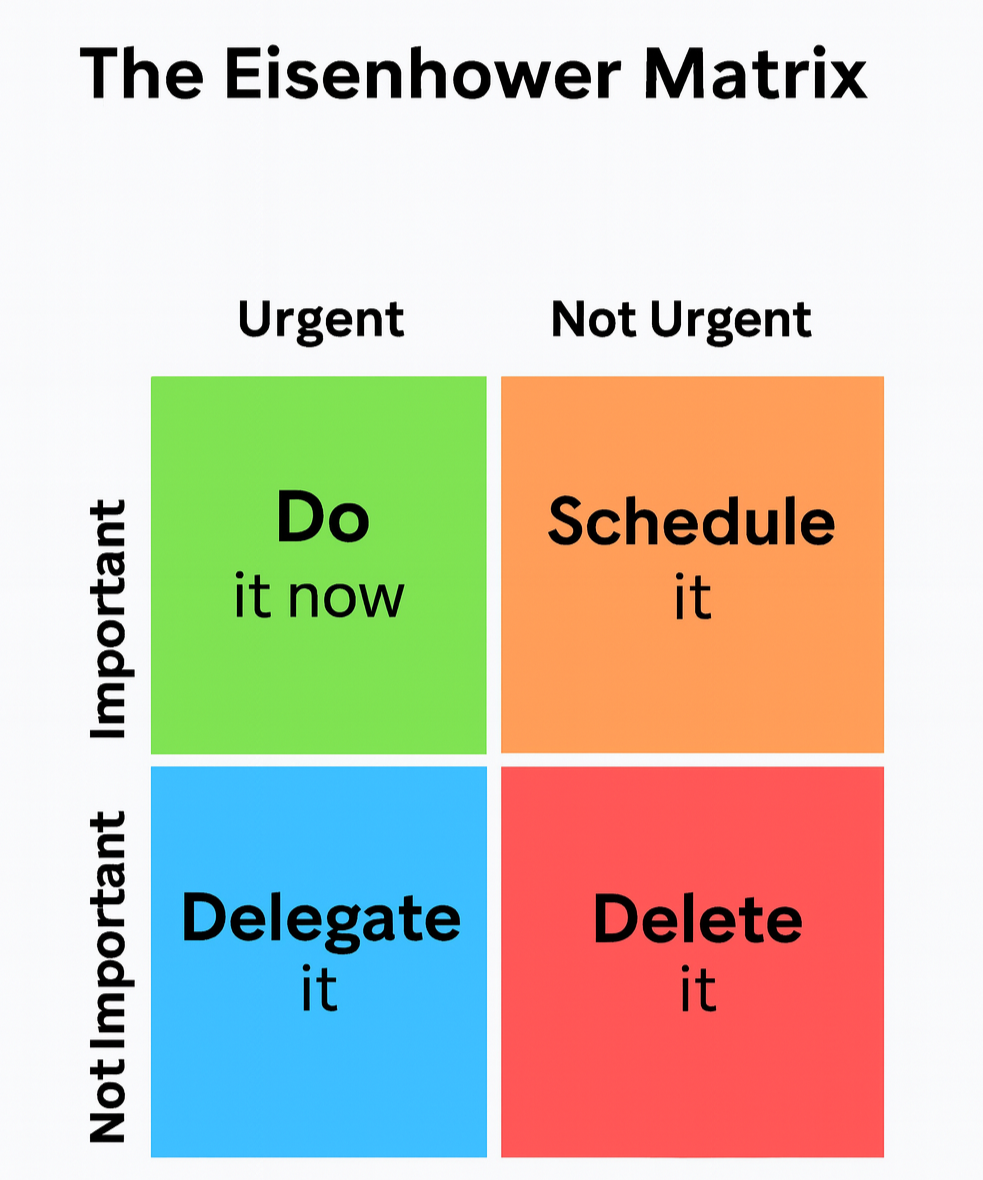
One powerful tool is the Eisenhower Matrix, which categorizes tasks by urgency and importance:
- Urgent + Important → Do immediately
- Important but Not Urgent → Schedule
- Urgent but Not Important → Delegate
- Not Urgent + Not Important → Eliminate
This simple framework prevents you from mistaking busyness for productivity.
Avoid the Multitasking Trap
Multitasking feels productive — but in practice, it usually reduces quality and increases total time spent. Our brains pay a heavy cost when switching contexts.
Instead:
- Focus on one task at a time
- Immerse fully
- Use timers if needed to move intentionally between tasks
Deep focus consistently produces better results than scattered effort.
Overwork Is Not a Badge of Honor
Working 70–80 hours a week is not sustainable — and research shows it doesn’t make you more productive. In fact, productivity declines sharply after 50 hours per week, leading to errors, burnout, and poor decision-making.
Rest isn’t laziness. It’s strategy.
A rested mind is sharper, more creative, and more resilient. That includes proper sleep, intentional breaks, and stepping away from your desk. Even a 20-minute walk can reset your thinking and elevate performance.
Be Intentional With Distractions
Social media can be valuable — but it can also devour hours with little return. Be clear about its purpose (connection, outreach, insight) and cap your time accordingly. Set limits. Use timers. Stay mindful.
Time drains rarely announce themselves — they quietly compound.
Invest Your Time Like a Strategic Asset
The goal isn’t just to work harder — it’s to work wiser. Early mastery of time management compounds throughout your entrepreneurial career, preserving energy, sharpening focus, and increasing impact.
Because in the end, success isn’t determined by how busy you are — it’s defined by how intentionally you invested your time.
 Laurie Stach
One Reply to “How to Get Everything Done in a Startup”